Free Shipping
Eco-Friendly Packaging
Easy Returns
Satisfaction Guaranteed
Free Shipping
Eco-Friendly Packaging
Easy Returns
Satisfaction Guaranteed
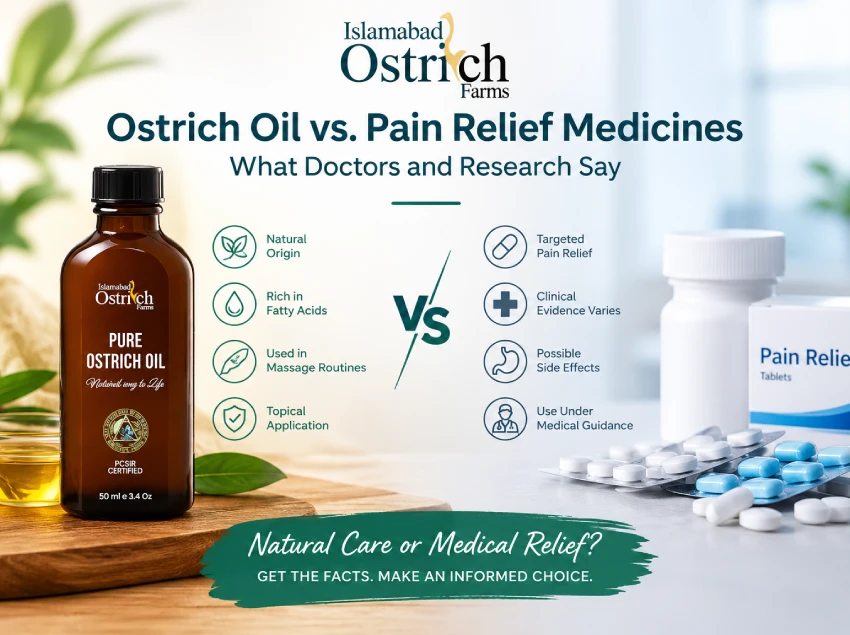
Pain can affect everyday activities, from walking and exercising to working and sleeping comfortably. When discomfort occurs, many people consider pain-relief medicines, topical gels, massage, or natural oils as part of their care routine.
One product attracting interest is ostrich oil, an animal-derived oil used in some topical massage products. But how does ostrich oil compare with conventional pain-relief medicines, and what does scientific research actually say?
In this guide, Islamabad Ostrich Farms explores the differences between ostrich oil and pain-relief medicines, reviews relevant research, and explains what to consider before choosing a product for your routine.
Ostrich oil is obtained from ostrich fat and processed for use in various topical products. It contains fatty acids, including oleic acid, linoleic acid, palmitic acid, and stearic acid, although the exact composition can vary.
Ostrich oil is used in some massage and body-care routines. People may choose it because they prefer oils for topical application or want to include massage in their everyday self-care.
However, being a natural product does not automatically mean that an oil is effective for treating pain or an underlying medical condition. Its benefits need to be assessed through appropriate scientific research.
Pain-relief medicines are designed to manage particular symptoms and conditions. The appropriate choice depends on the cause of the pain, its severity, and an individual’s medical history.
Common examples include:
Paracetamol is used to relieve pain and reduce fever. It may be suitable for certain types of pain, but its effectiveness varies depending on the condition.
It is important to follow the recommended instructions because taking too much paracetamol can cause serious liver damage.
Ibuprofen belongs to a group of medicines called non-steroidal anti-inflammatory drugs (NSAIDs). These medicines can relieve pain and reduce inflammation and swelling.
They are used for conditions such as muscle and joint pain, sprains, and some types of arthritis. However, NSAIDs are not suitable for everyone and can cause side effects, including stomach problems and, in some circumstances, kidney or cardiovascular complications.
Some medicines, such as diclofenac gel, are applied directly to the skin to help relieve particular types of muscle and joint pain.
Unlike an ordinary massage oil, a medicated gel contains an active pharmaceutical ingredient intended to produce a therapeutic effect. Evidence for topical NSAIDs is stronger for certain painful conditions than the evidence currently available for ostrich oil.
Important: The right medicine depends on the type of pain and your health circumstances. A doctor or pharmacist can help you choose an appropriate treatment.
| Feature | Ostrich Oil | Conventional Pain-Relief Medicines |
|---|---|---|
| Main purpose | Used in some topical massage and body-care routines | Used to treat specific symptoms and conditions |
| Scientific evidence | Emerging and limited for particular conditions | Varies by medicine and condition; some treatments have substantial clinical evidence |
| How it is used | Topical application according to product instructions | Oral medicines, topical gels, or other prescribed forms |
| Potential risks | Skin irritation or sensitivity | Side effects and contraindications depend on the medicine |
| Medical treatment | Not an established substitute for prescribed treatment | May be part of a clinician-recommended treatment plan |
These products should not be considered interchangeable. A massage oil and a medicine may serve different purposes, even when both are discussed in the context of pain management.
Research into ostrich oil is developing, and some human studies have reported promising findings. However, the evidence needs to be interpreted in the context of each study’s design and the condition being treated.
A randomized, double-blind, placebo-controlled clinical trial published in 2025 investigated ostrich oil for knee osteoarthritis symptoms.
The study included 90 participants who received ostrich oil or a placebo applied to the knees over two months. Researchers reported greater improvements in knee pain and stiffness in the ostrich oil group on several measured outcomes. However, there was no statistically significant difference between groups in the six-metre walking-time outcome at the end of the study.
These results are encouraging enough to justify further investigation, but one relatively small study does not establish that ostrich oil is an effective treatment for every person with arthritis or other types of pain.
A clinical trial published in 2026 investigated a specific medical application: chronic anal fissures.
The study compared glyceryl trinitrate (GTN) ointment alone with a combination of GTN and ostrich oil in 150 patients. The researchers reported differences in pain scores and some longer-term outcomes between the groups.
Importantly, this study examined a particular condition and a combination treatment. It does not establish that ordinary ostrich oil can replace standard pain medicines, nor does it demonstrate effectiveness for general muscle pain or joint pain.
The available human research suggests that ostrich oil deserves further scientific investigation in specific applications. Nevertheless, more high-quality studies are needed to establish its effectiveness, appropriate use, and safety across different conditions.
Research on one formulation or medical condition cannot automatically be applied to every ostrich oil product.
Ostrich oil should not be treated as a direct replacement for pain-relief medicines prescribed or recommended by a healthcare professional.
For example, a person experiencing persistent knee pain may need an assessment to determine whether the cause is osteoarthritis, an injury, or another condition. Depending on the diagnosis, treatment may involve exercise, physiotherapy, medication, or other interventions.
A topical oil may be incorporated into a personal massage routine if appropriate, but it should not delay diagnosis or necessary treatment.
If you are already taking pain-relief medicines, speak with a doctor or pharmacist before changing your treatment plan. Do not stop prescribed medication simply because you want to try a natural product.
Islamabad Ostrich Farms offers Pure Ostrich Oil for customers interested in topical massage and everyday body-care routines.
If you are considering adding it to your routine, keep these precautions in mind:
Do not apply a topical oil to broken skin or use it internally unless a product has been specifically approved for that purpose.
If you are interested in exploring ostrich oil for your topical massage routine, Islamabad Ostrich Farms provides an opportunity to learn more about its Pure Ostrich Oil product.
Before purchasing, review the product information, ingredients, available sizes, and instructions for use. Choose according to your personal preferences and intended application, rather than relying on claims of guaranteed pain relief.
Explore the product: Islamabad Ostrich Farms Pure Ostrich Oil
The product is intended for topical use as directed. It should not be represented as a proven cure for arthritis, injuries, or other medical conditions.
Ostrich oil and conventional pain-relief medicines have different roles. Medicines such as ibuprofen and topical diclofenac have established uses for particular types of pain, although they also have risks and are not suitable for everyone.
Early clinical research on ostrich oil has reported promising findings in specific settings, including knee osteoarthritis. However, the evidence remains limited, and more research is needed before broad claims about pain relief can be made.
For customers interested in Islamabad Ostrich Farms Pure Ostrich Oil, the sensible approach is to understand what the product is, follow its application instructions, and maintain realistic expectations.
Choose evidence-based care for pain, and consider topical oils as a separate part of your routine rather than a substitute for appropriate medical treatment.
There is not enough evidence to conclude that ostrich oil is generally better than conventional pain-relief medicines. The effectiveness of any treatment depends on the condition being treated.
A randomized clinical trial published in 2025 reported improvements in certain knee osteoarthritis symptoms among participants using ostrich oil. Further research is needed to confirm these findings and establish how broadly they apply.
Ask your doctor or pharmacist if you are unsure whether a topical product is appropriate alongside your medicines. Do not discontinue prescribed treatment without professional advice.
Ostrich oil is a natural animal-derived oil, whereas ibuprofen is a medicine with established pain-relieving and anti-inflammatory uses. They are not equivalent treatments, and ostrich oil should not be assumed to provide the same effects.
You can explore Islamabad Ostrich Farms Pure Ostrich Oil through the official online store and review the available product information before ordering.
No account yet?
Create an Account